William Faulkner’s Absalom, Absalom! is the American epic of the South, yet it remains relatively neglected. This is because it is a demanding work of fiction. The great Faulkner scholar Cleanth Brooks considered it Faulkner’s best work; others find it impenetrable. Both evaluations capture something essential about the novel and about Faulkner as a writer.

In Absalom, Absalom!, Faulkner integrates themes from antiquity and modernity—Rome, Greece, Christendom, and the American South—into a sweeping account of memory, inheritance, and moral judgment. America, the American South, and the leading families of Faulkner’s fictional Yoknapatawpha County rise to epic proportions; their actions define the South’s future, and their choices help explain the South’s fate in the Civil War.

At the center of the novel stands Thomas Sutpen, described at the outset as a “man-horse-demon.” Faulkner gives us competing storytellers of Sutpen’s life, some treating him as protagonist and others as antagonist. Quentin Compson must reckon with his own heritage and hometown history through the tension between loyalty and morality, legend and truth.

Faulkner was often called the American Shakespeare. His prose is as beautiful and demanding as the story itself. The novel evokes the feeling of sitting on a Southern porch after the Civil War, reckoning with the old South and its fate, while also taking on the dimensions of epic poetry. Fellows will consider what Faulkner reveals about the American South, the human soul, and the costs of inherited loyalties.

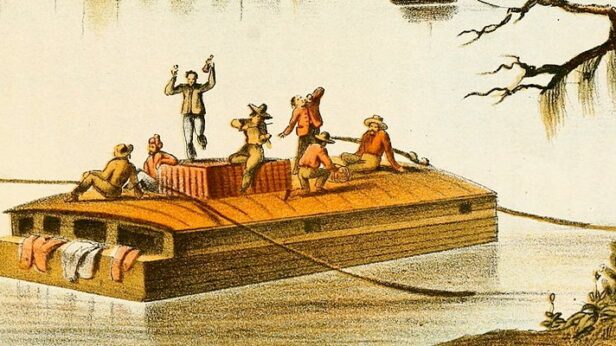
Image: Joseph Rusling Meeker’s Bayou Scene (1877)

Dr. Postell discusses how Faulkner reveals the Southern soul

Faculty

Sam Postell

Samuel Postell is Assistant Director of the Lyceum Scholars Program at Clemson University’s Snow Institute for the Study of Capitalism. He holds a Ph.D. in Politics from the University of Dallas, with a dissertation on Henry Clay, union, and legislative statesmanship. His teaching and research span American political thought, capitalism, politics and literature, and antebellum political life. He has a forthcoming book on Melville’s Moby-Dick entitled American Epic: Philosophy, Power, and Impiety in Melville’s Moby-Dick.

Lillian Law

Teaching Assistant

Lillian Law is pursuing an M.A. in English at The Catholic University of America and holds a B.A. in Political Science and French from Hillsdale College. Her background includes editorial and content-management work, and she studied William Faulkner’s Absalom, Absalom! in graduate school. A Hertog alumna, she will serve as teaching assistant for the Fall 2026 seminar on Faulkner’s novel.

Preview the Syllabus by Week/Session

Readings:

  • Chapters 1–4

Viewing & Listening:

  • William Faulkner reading from As I Lay Dying — This recording gives a sense of Faulkner’s cadence and the oral quality of his prose. I recommend reading at least part of the novel aloud.
  • William Faulkner, Nobel Prize Banquet Speech, 1950
  • The Caretaker, An Empty Bliss Beyond This World
  • Earth, The Bees Made Honey in the Lion’s Skull
  • Timber Timbre, Creep On Creepin’ On
  • Skip James, “Hard Time Killing Floor Blues”
  • Son House & J. D. Short, Blues from the Mississippi Delta

Discussion Questions:

Overarching Questions

  1. What are your gut reactions?
  2. What has happened thus far?
  3. What do you think about Thomas Sutpen?
  4. What do you think about Rosa?
  5. Close reading/reaction to the first 4 pages of the text

Chapter 1

  1. “Why should not Quentin be the one to hear it? … perhaps he will enter the literary profession… perhaps she wanted simply a younger person to listen… perhaps because she had to tell it, or because it would have to be told again.” (pp. 4–6)
    Miss Rosa, Mr. Compson, and the narrator all speculate about why Quentin has been chosen. Which explanation seems most persuasive? Does Quentin merely hear the story, or is he already becoming part of it?
  2. “…that commonwealth which is a child… to whom ninety years was but a little while…” (p. 6) “…he himself was not a being, an entity, he was a commonwealth….” (p. 6) “…partly responsible for it by being born at all…” (pp. 8–10)
    Why does Faulkner describe Quentin as a “commonwealth” rather than simply a young man? What is the “disease” Quentin inherits? Should anyone feel “partly responsible” for the past merely through birth?
  3. “We must just stay awake and see evil done for a little while, being powerless to hinder it… then clean ourselves of it afterward in whatever peaceful way we can…” (pp. 14–15) “…Heaven saw fit to let us lose…” (p. 15)
    Miss Rosa insists that the South deserved defeat. Why does she think this? Is this a statement about slavery, human pride, providence, or something else? Does Rosa condemn the South or attempt to redeem it?
  4. “I was born too late…” (pp. 17–18)
    Why does Rosa repeatedly insist that she was “born too late”? Too late for what? Heroism? Love? The Old South? Is this nostalgia, self-pity, or genuine tragedy?

Chapter 2

  1. “The wistaria, hardy, fecund, and ubiquitous…” (p. 27)
    Both Chapters 1 and 2 begin with wisteria. Why does Faulkner return to this image? How does it prepare us for a novel concerned with memory, decay, and the persistence of the past?
  2. “…that man whom he had never seen before… riding with the furious abruptness of a man with a secret destination…” (pp. 28–35) “…he could be patient now…” (p. 35)
    Our introduction to Sutpen changes dramatically in this chapter. Why does Faulkner emphasize both Sutpen’s violent energy and his remarkable patience? What does this reveal about “Sutpen’s design”?
  3. “…the town began to realise that this was no ordinary adventurer…” (pp. 41–45)
    Why does Jefferson finally intervene? Are its objections moral, social, economic, or simply rooted in fear of an outsider? Is the town right to resist Sutpen?
  4. “…perhaps they are not even events at all… perhaps memory believes before knowing remembers…” (discussion throughout Chapter 2)
    How do Chapters 1 and 2 suggest memory actually works? Is Faulkner interested in recovering history, or showing why history can never be fully recovered?

Chapter 3

  1. “…growing up in that closed masonry of females with that quality of furious indomitable faith… with the blind and irrational fury of a shedding snake…” (pp. 57–58)
    Is this account of Rosa’s childhood convincing? Is this explanation of her character convincing?
  2. “…the mask in Greek tragedy interchangeable not only from scene to scene but from actor to actor…” (pp. 60–61)
    What does this tell us about Sutpen?
  3. “…at war with his own flesh… though he did not know it…” (pp. 62–63)
    What war is Sutpen actually fighting? Against society? Against his origins? Against history? Against fate?
  4. “…Sutpen was acting his role too… perhaps not even he knew who the stage manager was.” (p. 71)
    Who is the “stage manager”? Providence? History? Slavery? Human pride? To what extent is Sutpen free?

Chapter 4

  1. “I will believe. I will. I will.” (p. 91)
    What exactly must Henry choose to believe? Why does belief—not evidence—become so central in this chapter?
  2. “…he inspired not envy but despair…” (pp. 97–98) “…Bon had usurped Henry…” (pp. 98–101)
    Why does Bon inspire “despair” rather than envy? In what sense has Bon “usurped” Henry? Is Bon truly heroic, or merely fascinating?
  3. “…perhaps he was simply too successful…” (p. 105)
    Why does Mr. Compson argue that Sutpen was “too successful”? How can success itself become tragic?
  4. “…the doom of the South… the doom of that family… almost the same doom…” (pp. 118–22)
    Mr. Compson compares the destiny of the United States with the destiny of the Sutpen family. Why? In what ways does the family become a symbol of the nation?

Readings:

  • Chapters 5–6

Viewing & Listening:

  • Jonny Greenwood, There Will Be Blood
  • Max Richter, The Leftovers: Music from the HBO Series
  • Mica Levi, Under the Skin
  • Blind Willie Johnson, “Dark Was the Night, Cold Was the Ground”
  • Geeshie Wiley, Presenting Geeshie Wiley

Discussion Questions:

Overarching Questions

  1. What is your gut reaction to the reading?
  2. What has happened?
  3. What do you think about Thomas Sutpen?

Chapter 5

  1. “‘Rosa.’ She called me Rosa…” (pp. 143–44)
    Why does Rosa react so violently when Clytie addresses her by her first name?
  2. “…the dream… the long dream from which there remained only the waking…” (pp. 145–54)
    What is Rosa’s “dream”? Why does she finally long to awaken from it? What does this suggest about memory and love?
  3. “…he merely began again…” (pp. 164–70) “…the analogy…” (p. 168)
    Why does Sutpen believe he can simply begin again after catastrophe? Is his confidence admirable, delusional, or both?
  4. “…that walking shadow…” (pp. 173–74) “…I was the sun which slew him…” (p. 174)
    Rosa describes Sutpen as a “walking shadow,” yet also claims that she herself was the “sun” that destroyed him. What does this mean? How did she “slay” him? How reliable is this interpretation? Is Rosa telling the truth about Sutpen—or about herself?

Chapter 6

  1. “‘She was no kin to you. No kin to you at all.’” (p. 181)
    Why does Shreve insist upon this distinction? Why does kinship matter so much in this novel? In what way does it matter? Should it matter?
  2. “‘Perhaps nothing is ever finished… perhaps it was not fixed at all…’” (pp. 184–85)
    Does Faulkner present history as something fixed or something continually reconstructed? What role do Quentin and Shreve play in shaping the story?
  3. “‘Wait for what must be.’” (p. 207) “…that mirror…” (p. 208) “…that brooding fierce unflagging jealous care…” (p. 208)
    How do the cemetery scene, the mirror, and Clytie’s devotion deepen the novel’s understanding of memory, death, and fate? What is everyone waiting for?
  4. “‘You were not listening… because you knew it already.’” (p. 222)
    How can Quentin “know” a story before hearing it? What does this suggest about inheritance, memory, and the burden of Southern history?

Readings:

  • Chapter 7

Viewing & Listening:

  • Bruckner, Symphony No. 9 in D Minor
  • Bobby Krlic, Midsommar
  • Nick Cave & Warren Ellis, The Assassination of Jesse James by the Coward Robert Ford
  • Robert Johnson, King of the Delta Blues Singers
  • Robert Johnson, “If I Had Possession Over Judgment Day,” in particular
  • Charley Patton, Presenting Charley Patton

Discussion Questions:

Overarching Questions

  1. What is your gut reaction to the reading?
  2. What has happened?
  3. What do you think about Thomas Sutpen?

Chapter 7

  1. “He did not need courage… he needed only a design.” “He did not need courage. He did not need kindness or pity either. He needed only a design.”
    Throughout the novel, Sutpen has often appeared almost superhuman in his determination. Does Chapter 7 confirm that impression, or complicate it? What exactly is Sutpen’s “design”? Is it simply ambition, or is it an attempt to overcome the humiliation of his childhood? At what point does a legitimate desire for dignity become moral corruption?
  2. “You are poor… then you will have to learn the difference between white men and black ones.” “The man said, ‘Never come to the front door again. Never come to a front door but that one. Go around to the back. … You are poor, are you? Then you will have to learn the difference between white men and black ones.’”
    This is arguably the most important scene in the novel. Why does this encounter become the defining moment of Sutpen’s life? What lesson does the boy Sutpen actually learn? Should he have learned a different lesson? Does Faulkner suggest that Southern society—not simply Sutpen—is responsible for the tragedy that follows?
  3. “He found that he had been betrayed by innocence.” “He discovered that the innocence in which he had believed had betrayed him.”
    Sutpen is repeatedly presented as someone who acted from innocence rather than malice. How is he innocent? Is this persuasive? To what extent is he a victim of the society that formed him? At what point does he become responsible for perpetuating the very system that humiliated him?
  4. “So he merely corrected the mistake.” “He merely saw where he had failed, corrected the mistake, and proceeded with the design.”
    One of the most chilling aspects of Sutpen’s character is his tendency to think of human relationships as problems to be solved. Why does he describe marriage, children, and even people themselves as “mistakes” or “ingredients”? Is Sutpen incapable of love, or has his ambition displaced every other human affection?
  5. “The design.” “He had only one purpose: to acquire the land, the house, the wife, and the son.”
    By the end of this chapter, we understand exactly what Sutpen hopes to accomplish. Why are these particular “ingredients” so important? Is Sutpen attempting to create a family, or merely the appearance of one? What is missing from his design? How does the episode with Wash relate to Sutpen’s “design”?
  6. Quentin remarks that Sutpen “never looked back.” Throughout the chapter, Sutpen insists on moving relentlessly forward, refusing to dwell on regret or remorse. How does this contrast with Quentin, Rosa, and Mr. Compson, who seem unable to escape the past? Which attitude is more destructive: Sutpen’s refusal to remember, or Quentin’s inability to forget? Does Faulkner suggest that either approach offers genuine freedom?
  7. “It wasn’t Sutpen’s story anymore.”
    By the end of Chapter 7, Quentin and Shreve begin piecing together Sutpen’s life for themselves, imagining conversations and motives that no narrator could actually know. As readers, how much confidence should we place in their reconstruction? Does Faulkner believe history can ever be recovered objectively, or is every historical account inevitably shaped by imagination? Why does Faulkner allow Quentin and Shreve to become co-authors of Sutpen’s story rather than simply its audience?

Readings:

  • Chapters 8–9

Viewing & Listening:

  • Krzysztof Penderecki, “Threnody to the Victims of Hiroshima”
  • Abul Mogard, Above All Dreams
  • Blind Willie McTell, Presenting Blind Willie McTell
  • Mississippi John Hurt, 1928 Sessions
  • Jason Isbell, “Decoration Day”

Discussion Questions:

Overarching Questions

  1. What are your gut reactions?
  2. What has happened?
  3. What do you think about Thomas Sutpen?

Chapter 8

  1. “So it was Charles Bon…”
    Why does the revelation of Bon’s identity explain everything and yet leave so much unresolved? Why is Henry ultimately unable to accept Bon? Is race, incest, honor, or something else the decisive issue?
  2. “He must not marry Judith.”
    Why does Sutpen forbid the marriage only after Bon returns? Was there ever a morally acceptable solution available to him? How does every possible choice seem destined to produce tragedy?
  3. “Perhaps they invented it between them.”
    Throughout the novel Quentin and Shreve increasingly reconstruct scenes neither of them witnessed. Where is the line between historical reconstruction and fiction? Does Faulkner believe historical truth can ever be fully known?
  4. “Maybe nothing ever happens once and is finished.”
    This idea first appeared near the beginning of the novel but seems to govern its ending. How has your understanding of this statement changed? What does Faulkner suggest about memory and history?

Chapter 9

  1. “Why do you hate the South?” “I don’t hate it! I don’t hate it!”
    The novel ends with Quentin’s famous denial. Why does Shreve ask the question? Why must Quentin repeat his answer? Does he convince you—or himself? What does this exchange reveal about Quentin’s relationship to Southern history?
  2. “They are still there.”
    The novel repeatedly insists that the past remains present. What, by the end of the novel, is still “there”? Sutpen? Slavery? Memory? Guilt? Is the past something that can ever truly disappear?
  3. “Maybe this is all anybody ever can know about anybody.”
    After nine chapters of conflicting narrators and reconstructed scenes, what confidence should readers place in the story they have received? Is Faulkner suggesting that historical truth is impossible—or that it can only be approached through many competing voices?
  4. “Absalom, Absalom!”
    The novel’s title comes from King David’s lament over his dead son. Why does Faulkner choose this Biblical cry as the title of the novel? Who is David? Who is Absalom? Is the novel finally about fathers and sons, the South itself, or the universal tragedy of inheritance? Does the novel fit within the Christian tradition, the Greek epic tradition, both, or neither? Does the South fit within the Christian tradition, the Greek epic tradition, both, or neither? Does America fit within the Christian tradition, the Greek epic tradition, both, or neither?
  5. Is Thomas Sutpen a hero or a villain? If villain, does he possess any virtues? If a hero, what are the virtues or vices that render him tragic?

Other Courses You Might Be Interested In

Mark Twain’s Tom Sawyer & Huckleberry Finn

Read two great American novels that launched a literary & cultural revolution.
Larry McMurtry’s Lonesome Dove

Read America's national epic of the West—& how history became legend.
America at 250

Mark America’s 250th by reading the words through which the republic has imagined, tested, & judged itself.
Herman Melville’s Moby Dick

Explore the fundamental human question of the nature and existence of God with Melville's great American novel.

Toni Morrison’s Song of Solomon

Explore memory, family, inheritance, myth, & freedom in Morrison’s acclaimed novel.
African American Political Thought

Learn how the political tradition of Black Americans has made an indelible impression on American history.